Holy Euphemism, Batman!

So ever since I started blogging I’ve struggled with what to do about the problem of how to talk about that thing. You know, the thing we religious people are always talking about, that divine, holy, transcendent Thing that, according to Maimonides, we can’t even say anything about, except what we know it isn’t.

You see, there’s this tradition in Judaism of not referring to G-d directly, on the principle that the name of the Holy One, Blessed Be He is so awesomely powerful that to say it frivolously or without being absolutely pure is to invite disaster. For a fun illustration of this principle with lots of computers, ants and cranial drilling, I invite my two or three readers to go watch that movie Pi, if they haven’t already.

This tradition kicks off fairly early. In Exodus, when Moses asks HaShem to reveal His name (oh watch how the pronouns come rolling in!) so that he can give an account of himself should the elders of Israel ask who might have sent him on his crazy task of liberating them from bondage, HaMakom is evasive, merely replying that “Ehyeh asher ehyeh,” or “I will be what I will be.” Lots has been written about this. Suffice it to say that the Bible itself is fairly bizarre when it comes to this subject, alternating between the oddly plural Elohim (literally “gods”) and the four-letter word we gloss as “Adonai” (meaning something like “My Lord”), but which actually consists of the letters yud-hey-vav-hey and which nobody now knows how to properly pronounce. This is because the only person who was ever allowed to speak that word (which the tradition regards as the proper name of He Who Spoke and Caused the World to Be) was the high priest, and that only on Yom Kippur, when he was safely ensconced in the Holy of Holies in the temple and nobody else was around to hear. This obviously became a problem once the second temple was destroyed by the Romans, and the secret of the original, correct pronunciation was lost. All we had from that point on was Adonai, of which all we can say for certain is that it definitely isn’t how to properly pronounce that word.

But it’s a funny thing about people. If they’ve been raised never to say a particular word, such that the word itself becomes lost, then the euphemism itself becomes the word, and they’ll start avoiding saying that. In current usage, we tend not to say (or in many cases, even write) Adonai except when we’re reading from the Torah and specifically using that word as a stand-in for the four-letter name that we cannot (not even may not at this point, simply cannot) pronounce. In accordance with the age-old principle of building a fence around the Torah, the euphemism itself becomes taboo and we’re forced to use a euphemism for the euphemism. Hence the proliferation of verbal constructions (many of which appear in the previous couple of paragraphs) employed to avoid having to invoke G-d by the euphemism for his name. At some point, even the word G-d itself (which doesn’t even belong to the constellation of actual Jewish terms for divinity, coming as it does from Germanic roots) becomes vaguely taboo, which is why a lot of people will omit the middle vowel, as I just did twice in as many sentences.

The thing is, I’m deeply sympathetic to the idea that you shouldn’t refer to God by name, because to name something means risking deluding yourself that you know what it is, and if there’s one thing we know about God, it’s that we don’t know what God is. I’m also the kind of person who picks up superstitions and verbal tics like lice. It’s all part of my rather obsessive personality, combined with my compulsion to strive for perfect accuracy in grammar and seek out the appropriate word at all costs. Nevertheless, when I look at a previous blog post and see four or five “G-d”s in a row, I’m forced to ask myself: What’s the point? Why go to the trouble of X-ing a word that amounts to a euphemism for a euphemism for a euphemism, several languages removed? Especially in light of the fact (or rather, my suspicion) that, should we ever actually learn how to say the word that was spoken by the high priest alone in that stone chamber on the holiest day of the year, even that itself wouldn’t actually be the name of God, but simply another euphemism, another marker pointing toward that which is beyond all language, beyond all consciousness, the inconceivable Infinite against which our minds must shatter like waves breaking against a cliff. And so, I’m resolved henceforth to omit the hyphen and leave the “O” where it is, and instead to contemplate each time I use it the emptiness of all our words for God.
Some late-night rambling

What elevates us may be that which is most universally human, but sometimes I think that most defines us as individuals are our quirks and obsessions. Ultimately, to find a way to offer up the strangeness within us to G-d, this constitutes the basic religious project of our lives.

This is true not only of individuals, but at the tribal/communal level as well. This is one reason why the idea of a truly universal religion is absurd: If the raw material differs, how can the process of refning it be the same?

Postulate: That all spiritual experience begins from the particular and moves outward into the universal. That furthermore it is the nature of the particular experience from which it begins that defines the unique character of a religious tradition. It becomes an indelible fingerprint that can never be removed without killing the tradition, no matter how abstract and universalistic the tradition becomes.

In Judaism, the particular that our universal understanding of G-d grows from is a shared sense of history and national identity. Our conception of G-d began with the god of Abraham, Isaac and Jacob. It was only as this idea was refined in the crucible of subsequent generations of prophetic insight that the universalistic kernel buried inside the national experience could begin to grow and bear fruit.

At some point along the way the G-d of Israel became also the G-d of all the nations, the transcendent Master of history, while still remaining at the same time our G-d, the G-d with whom we shared a unique and irreplacable special relationship. This seemingly paradoxical standpoint is not unique to Judaism. Indeed, it represents a central problem at the heart of any religion developed enough to have moved out of the stage of the purely particular religious experience. Nearly all religions recognizable as such have begun to make this transition. It might be said to define the boundary between religion itself and the more anarchic “spirituality” that forms the primal matter of more formal/developed religion.

D’var Torah: Parashat Chukat

Parashat Chukat is bound up with the theme of death. The parashah starts out with a set of regulations for the ritual of the red heifer, which is intended to purify a member of the Israelite community from the contamination incurred through contact with a dead body. Almost immediately after this the Torah reports the death of Miriam, the prophetess and sister of Moses and Aaron, and not long after this Aaron too is called to his death, leaving Moses alone to lead the people during this last phase of the journey to the land of Canaan.

Two deaths, two significant and very different deaths.

Given the prevalence of death throughout, it seems significant that its name is Chukat. Chok, from which chukat is derived, is one of a trio of terms used by the Torah to refer to mitzvot commanded by G-d. We’re used to talking about positive and negative commandments, but another of the traditional ways of talking about mitzvot is to divide them into mishpatim, edot and chukim. According to the rabbis, mishpatim are rational commandments–things we would be able to know were right or wrong independently of the Torah, purely through the power of reason. Edot are commandments intended to memorialize or represent something, such as eating matzah on passover to remember the haste with which the Israelites were forced to depart Egypt–not derivable a priori without the text of the Torah to serve as a guide but nevertheless rationally connected with the historical narrative contained therein. Chukim, however, are commandments with no logical basis, not grounded in any apparent external justification save for the transcendent word of G-d breaking forth like lightning through the clouds of the rational order.

In a sense, the death of Aaron is similar to a mishpat: Bound up with G-d’s decree that neither Moses nor Aaron will live to cross over the Jordan to set foot in the land, it seems to follow logically from the episode almost immediately preceding in which the brothers stumble in the matter of the waters of Meribah. What is more, his death is decreed ahead of time by G-d. Aaron is given the chance to prepare, emotionally as well as practically, for his own death, and clear instructions are given for the transfer of priestly authority from him to his son Eleazar.

Not so with Miriam. Her death seems to come out of nowhere, interrupting the normal flow of life like a clap of thunder from a cloudless sky:

The Israelites arrived in a body at the wilderness of Zin on the first new moon, and the people stayed at Kadesh. Miriam died there and was buried there. (Numbers 20:1)

No warning, no clear justification, no chance to prepare. And no clear mention made of anybody, whether the people as a whole or her brothers Moses and Aaron, mourning her. Aaron the people mourn for thirty days, but for Miriam, not a peep. What we get instead is an immediate narrative jump to an account of the people panicking because they are thirsty and there isn’t any water. Given what we know about the importance of juxtaposition in biblical narrative, this shift is too sudden for us to be without suspicion that there’s a connection, and indeed the rabbis are with us in our suspicion. Because as it turns out there is a tradition in the midrash that associates Miriam with the supply of water that kept the people from dying of thirst in the desert. As one midrash has it, the manna that fed the people was provided on account of the merit of Moses. Aaron’s merit was responsible for the pillar of smoke that guided the people through the wilderness. But it was on account fo Miriam’s piety that the people were able to find water. Some accounts talk of a miraculous “Well of Miriam” that followed the Israelites wherever they went, springing up from the ground every time they made camp. These stories aren’t so far-fetched when we consider that Miriam’s most significant moments are associated with water–waiting by the banks of the Nile to observe and intervene in the fate of her infant brother, and leading the women of the people in song and dance on the shore of the Sea of Reeds in praise of G-d’s miraculous deliverance of the people from the clutches of Pharaoh’s army.

So, Miriam, the largely unsung prophetess who has been responsible for ensuring that there is water for the people to drink dies suddenly, without warning or any indication from G-d as to how this important responsibility is going to be handled in her absence. The people are understandably upset, especially given that as far as we can tell the water pretty much immediately dries up after this. Moses and Aaron seek G-d’s help, and are instructed in what to do. But–instead of simply following G-d’s instructions and commanding the rock to bear water “before the very eyes” of the community, Moses peevishly berates the Israelites, calling them “rebels,” and strikes the rock twice with his staff. A subtle variation between intent and execution, its seeming insignificance is belied by the harsh judgment attendent on it–that neither Moses nor Aaron will ever set foot in the promised land.

So what, exactly, is the failing that prompted this judgment? There are many opinions about this, but here’s one interpretation in light of what we’ve surmised about Miriam’s role: The sudden and unexpected death of an important and respected member of the community would understandably come as a great shock to the people. It’s significant that in this instance G-d does not begrudge the people for their fear and confusion. Moses’s accusation in this case is unjust–the people are understandably and deservedly upset. But rather than confidently and compassionately stepping forward and demonstrating to the people that life will go on, that despite the great loss of her passing others will step forward and shoulder the responsibilities she held, Moses, whether out of grief or his own sense of frustration at having yet another responsibility thrust upon him, lashes out at the complainers in anger. And Aaron, who might have remonstrated with his brother and made him see that the people were more deserving of his sympathy than his anger, remained silent, perhaps too bound up in the chamber of his own grief to respond to the emotional needs of others.

If this is so, then perhaps it explains why Miriam, unlike Aaron, goes unmourned in the text. Moses and Aaron, too bound up in their own highly personal responses to their sister’s death, are unable or unwilling to externalize their grief, share it with the community and begin moving along the painful path from despair to healing. If so, their stumbling at this crucial juncture is a powerful reminder to us of the importance of  coming together in the wake of a disaster, of forging a collective response to the sometimes incomprehensible decrees of G-d that, in the depths of our isolation, can only ever appear starkly meaningless.

Shiluach ha-Ken

If, along the road, you chance upon a bird’s nest, in any tree or on the ground, with fledglings or eggs and the mother sitting over the fledglings or on the eggs, do not take the mother together with her young. Let the mother go, and take only the young, in order that you may fare well and have a long life. (Deut. 22:6-7)

How often do you actually come upon a mother bird in its nest?

How often do you actually come upon a mother bird in its nest?

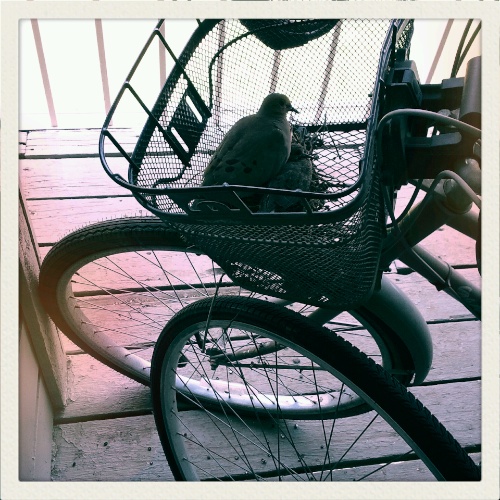
I was looking out the sliding door to our porch the other day and found that a mourning dove had built a nest in the basket of Emily’s bike and was sitting there on top of her rather scruffy-looking offspring. This probably says something troubling about the extent to which we make use of our bicycles, or our porch for that matter. That said, it made me think of this passage from the Torah and the mitzvah of shiluach ha-ken, or sending away the mother bird.

What I find noteworthy about this passage, and about similar commandments throughout the Torah (such as the mitzvah of not yoking an ox alongside an ass, or sacrificing a mother animal and her offspring on the same day) is the way they seem to to give us grounds for questioning the somewhat simplistic criticism of Judaism and its sister faiths that they presume a worldview in which humans are essentially cut off from nature, existing in a completely separate ethical sphere from the rest of God’s creations.

The criticism stems at least in part from the famous passage in the first chapter of Genesis in which God commands the humans to “Be fertile and increase, fill the earth and master it; and rule the fish of the sea, the birds of the sky, and all the living things that creep on earth.” (Gen. 1:28) The argument is that the biblical mindset regards humans as different in kind from the rest of created nature, set over and apart from the natural world. Where other faith traditions (the animistic practices of indigenous peoples are often mentioned in this context, as, for different reasons, is Buddhism) emphasize a continuity between humanity and the rest of the natural world, the overarching tendency within the Abrahamic faiths has been to establish a radical discontinuity between human beings and the rest of creation, grounded in a transcendent spiritual order in which animals, plants etc. do not participate.

I will not go so far as to argue that this point of view is entirely without basis in the tradition. Certainly Biblical Male and Female commanded by God to “fill the earth and master it” have a different attitude toward nature from that of the animist who looks to plants, animals and the earth itself as sources of spiritual insight. Nevertheless, I would argue that biblical commandments such as shiluach ha-ken and the rabbinical discourse concerning the ethical treatment of animals that develops out of them point to a sense in which humans and animals are seen to share certain important qualities in common which open up the possibility of an ethical responsibility grounded in our shared susceptibility to pain, disease, fear and all the host of other manifestations of the pathos of living as an embodied, sentient being in a world haunted by the specter of death.

Articulating a consistent, authentically Jewish theory of the relationship between humans and nature is the work of an entire book (or several). Nevertheless, I think it’s important to at least acknowledge that a worldview that sees the natural world as essentially the responsibility of humankind (and I feel like I’m in good company arguing that this is an interpretation consistent with the biblical understanding of possession) is not necessarily inconsistent with a recognition of important bonds of commonality between us and our fellow creatures that create a shared ethical space within which it is possible to talk about our obligations toward other species.

As for the mourning dove and her offspring in the bicycle basket, I’m afraid that when I opened up the door the next day to bring outside a mint plant which I’d received as a present, they both got nervous and fluttered away. I’m left feeling a little bad for having bothered them, and hoping that the mother, at least, turned out alright.

Truth and Fiction, Part 2

As is so frequently the case, it’s been a while since my last post, but I did want to continue the thought I had begun previously. Looking back over the direction I was heading, it now seems to me that what I was saying was starting to get needlessly general, so in this concluding post for Truth and Fiction, I’d like to bring it back to the basic question that might have occurred to anyone reading the previous section: Why Passover? In other words, given that we struggle constantly with the role of the miraculous in religion, why in particular does the story of Passover, and more specifically the moment of the parting of the Sea of Reeds, arouse most intensely these questions for us?

I think that to begin to answer this we have to acknowledge that though the Tanakh is filled with examples of G-d’s miraculous intervention in the affairs of humanity, the…what is the word I’m looking for here? The role, the tenor, the mood of the miraculous event is different from moment to moment in the text. Through most of Genesis the narrative has a very folkloric quality. G-d walks and talks with humanity. Angels pop up here and there, mostly as messengers, sometimes even to marry humans and have children with them. G-d gets angry at humanity and floods the whole world, and only a few generations later mankind gets together and tries to build a tower to heaven. What I’m getting at here is that there’s a mythic quality to much of Genesis that makes it feel much less urgent to strictly define in what sense the stories we’re reading should be regarded as “true.” Certainly there are people who persist in regarding the biblical account of creation, for example, as literally true in a historical sense, but for most of us it isn’t too difficult to regard the stories as metaphors and feel quite comfortable dealing with them at that level.

Not so in Exodus. By the end of Genesis, the narrative has already switched over to a more historical, “realistic” perspective, and with the opening of Exodus this transformation is complete. No longer are we operating in a folkloric mode in which a few larger-than-life figures loom large against a mostly empty background. Exodus opens in such a way as to signal loud and clear that now we are dealing with a much broader stage, in which the political and economic circumstances of nations have as big a role to play as the personalities of individuals:

A new king arose over Egypt, who did not know Joseph. And he said to his people, “Look, the Israelite people are much too numerous for us. Let us deal shrewdly with them, so that they may not increase; otherwise in the event of war they may join our enemies in fighting against us and rise from the ground.” (Exodus 1:8-10)

This semihistorical mode is an important part of what makes the Passover story so powerfully relevant in the lives of each generation that retells it. The ethnic tensions that drive the story, as well as the repression and consequent longing for freedom that spring from them, are as real and plausible to us now as they were thousands of years ago. That this relevance is powerful enough to transcend not only time, but also language and cultural identity, speaking meaningfully not only to Jews but to people throughout the world from a vast variety of different backgrounds and historical contexts, is testament to the story’s status as one of the foundational organizational narratives of the human species.

Nevertheless, it is precisely this historically plausible quality of the narrative that makes it seem so vitally important to determine how we are supposed to relate to the miraculous events which occur throughout, breaking forth like lightning against the cloudy sky of historical reality. Because if indeed Exodus starts out by constructing a plausible historical and political stage, it is only with the intention of ultimately destroying it. At its heart, the story of Exodus is about the miraculous power of G-d breaking in from outside the bounds of the seemingly solid cage of political reality in order to change it beyond all recognition.

It is this, I think, that we sense when we fixate on the parting of the Sea of Reeds and the question of whether it “actually happened” or not. When the sea parts and the people of Israel cross on dry land to escape their oppressors, something infinitely greater is at stake than the mere question of G-d’s ability or willingness to suspend the ordinary functioning of the laws of nature. Contained within this fantastic event is the thesis that there is a power within and behind the world utterly opposed to systems of repression, able to free us from the bonds of historical necessity that seem to dictate that the way of the world is the foot of the powerful upon the neck of the weak. My belief is that, subconsciously at least, when we ask about whether Moses really parted the Sea of Reeds, we’re not really inquiring about the simple factual matter, but about the radical thesis it communicates.

Truth and Fiction, Part 1

At the seder last night someone asked me, “So, did Moses really part the Red Sea?” Totally unprepared and not sure what to answer, all I could think of to say was, “Of course not, God did.” Kind of an evasive response, actually, but I was on the spot.

I’ve been getting these kinds of question a lot lately since it came out I’m going to be attending rabbinical school. The assumptions of knowledge and competency they imply can be disconcerting on occasion, but it does keep me on my toes. But it did occur to me later that this question, or some version of it, has been asked at every seder I’ve been to, and that made me wonder if that says something interesting about us and our relation to the holiday.

I mentioned this to my wife this morning, and what she said pretty much hits the nail on head, I think: “They want to know if they’ve been fooled by religion.” And don’t we all, really? This comment greatly reminded me of the way Emmanuel Levinas begins the preface to his great work on ethics, Totality and Infinity: “Everyone will readily agree that it is of the highest importance to know whether we are not duped by morality.” Same question.

It’s a common question, in fact, a question that has been floating around like an angry hornet in the room ever since the advent of modernity. In fact, it may be precisely this question which constitutes the distinction between “we moderns” and the era that came before us. None of us can escape it, from the skeptic who’s been stung by the hornet one too many times to the fundamentalist whose attempts to ignore it invest every word and deed with a crazed intensity that his ancient forbears would never have recognized as their own. No one can sleep in a room with an angry wasp and none of us can feel totally comfortable with this question buzzing around.

I think the crux of this anxiety revolves around the diverging paths that Fact and Value have taken over the past several hundred years. This is a horribly oversimplified way of putting things, I know, but I would argue that whereas Fact and Value used to form two sides of a single concept known as Truth, the whole story of the past half millenium or so has been about the two breaking apart in uncomfortable and destabilizing ways and various more or less unsuccessful attempts to bring them back together.

More on this later. In the meantime, if anyone wants to weigh in, please post a comment here on my blog or Facebook. It would seriously make my day.

Dvar Torah- Acharei Mot (Shabbat Hagadol)

Today is Shabbat HaGadol, the last Shabbat before the beginning of Pesach. One of the explanations I’ve heard for why this day is called the Great Shabbat is that in the past it was customary for the people to ask the rabbi all their last-minute questions concerning the halachah for the upcoming holiday. I think most people would agree that Passover is one of the more complicated Jewish festivals to observe, and it makes sense to me to imagine a kind of informal Q-and-A session very similar to our discussions here in shul the past several weeks, with the rabbi explaining the finer points of kashrut to a community of people happy for the shabbos break in the long and hectic process of eliminating every last trace of hametz from the house. Unfortunately, I’m barely qualified to answer questions about my own kitchen, let alone anyone else’s, but I thought it would be nice to commemorate the day by taking a look at the special haftarah we read for Shabbat HaGadol.

There’s a strange dynamic that plays out in the section of Malachi that makes up this passage. The prophet’s theme is the coming of the Messianic era, envisioned here as God’s return to His Temple. Malachi doesn’t see this powerfully redemptive event as something gradual or subtle, the slow fade of night’s giving way to the light of dawn. On the contrary, as it says in a passage a little before the beginning of our haftarah, “the Lord whom you seek shall come to His Temple suddenly.” (Mal. 3:1) A frantic energy pervades this text, a sense of great, world-shattering change just around the corner, not yet here but already filling our ears with the echoes of its impending arrival, causing the wicked to tremble and the righteous to rejoice. “For lo!” says Malachi, “That day is at hand, burning like an oven.” (Mal. 3:19)

And yet, when I read this passage I detect a certain tension in the prophet’s words. He seems unable to resolve the question of how this day is to come about. On the one hand, God’s sudden arrival is treated as something fixed and inevitable, seeming to arrive out of nowhere like a whirlwind or a flood, sweeping everyone and everything along in its inexorable path. But inserted into the midst of this powerful language of upheaval and reversal, of God stepping forward to act as an accuser against those who have subverted the moral order of society, there seems to be a note of pleading, a sense in which God is virtually begging the people to return to Him. “You have been suffering under a curse, yet you go on defrauding Me–the whole nation of you. Bring the full tithe into the storehouse, and let there be food in My house, and thus put Me to the test–said the Lord of Hosts. I will surely open the floodgates of the sky for you and pour down blessings on you…” (Mal. 3:9-10)

This sense of pleading, of God’s unfulfilled desire for the repentance of His people, inserts an element of conditionality that seems to contradict the sense of inevitability that otherwise pervades this passage. These two conflicting visions of the coming of God and the establishment of the Messianic Age–the overwhelming flood on the one hand, the uncertain event balanced tentatively on the knife edge of the people’s repentance on the other–form a counterpoint to each other, a question that rings unspoken throughout the text: Is the world to be repaired through a unilateral act of God or through the repentance and patient effort of humanity?

Malachi never explicitly answers this question and the tension it creates is never fully resolved, even by the later rabbis, who could not agree on whether the coming of the Moshiach was something we could bring closer through repentance and good deeds or whether it was a fixed event the time of which is established by God and which nothing we say or do can alter. In the end, Malachi leaves the matter thus:

“Lo, I will send the prophet Elijah to you before the coming of the awesome, fearful day of the Lord. He shall reconcile parents with children and children with their parents, so that, when I come, I do not strike the whole land with utter destruction.” (Malachi 3:23-24)

One thing I note about this passage is that the coming of the day of the LORD does not seem to be reliant on any particular change of heart in Israel. It isn’t as if Israel finally shapes up and God returns. On the contrary, when the day arrives it requires Elijah’s preparatory work simply to make sure that Hashem’s presence doesn’t utterly destroy the land. And yet, this process of social reconciliation at the most basic and intimate level is something that evidently must take place before God can return. This seems to hint at a particular attitude toward sin and transgression, namely that the prophet (and by extension God) understands that transgression is going to be a part of life, the cost of the divine coming into relationship with flawed, limited humanity.

To clarify what I mean, let’s take a look at a passage from today’s Torah portion, where it talks about the ritual the priest must undertake on Yom Kippur to cleanse the people of their sins:

“Thus he [i.e. the priest] shall purge the Shrine of the uncleanness and transgression of the Israelites, whatever their sins; and he shall do the same for the tent of meeting, which abides with them in the midst of their umcleanness.” (Leviticus 16:16)

The word that’s suspiciously absent from this passage is “if.” The possibility that there may not be any transgression to purge is not even entertained. One might accuse the author of being a bit uncharitable. In fact, this is evidence of the kind of understanding to be found only in the relationship between parents and their children and God and His people. God is recognizing the fact that the establishment of a relationship between Him and us inevitably implies the breakdown of this selfsame relationship, and rather than taking this as reason to simply give up on the whole thing before it has begun, God is taking this fact into account by building the mechanism for repairing the relationship into the terms of the relationship itself.

In Rabbi Sloveitchick’s book Halakhic Man, he argues against the mystical idea that the holy is something separate from the world, separate from experience. On the contrary, he says, Judaism teaches us that the holy is a basic category of experience in the world as we experience it. In other words, God’s natural home is among us, and the notion of His dwelling on some lofty, transcendent plane utterly separate from the world in which we live is indicative, not of the natural state of things, but of a profound breach in the way the world is supposed to work. God’s yearning to be with us is at least powerful enough that He is willing to look past the inevitable breach toward the possibility of repair. This awareness of the inherent limitations of a relationship between humanity and the divine is present as well in the concluding passage of Malachi.

This sense of God’s constant yearning to be closer to us, and willingness to tilt the balance in favor of reconciliation between us and Him, is something I’d like to carry with me as we enter into the festival celebrating the most profoundly redemptive event in our people’s history. With this sense in mind, the intensity and violence of Malachi’s vision of the God’s return can be seen not as something unnerving, but as a powerful expression of God’s desire for our participation in the repair of the world. A desire strong enough to free a people of slaves from the clutches of Egypt thousands of years ago must surely have echoes strong enough to inspire us to devote ourselves to creating the conditions for similar redemptive events in our own time.

D’var Torah: Parashat Yitro

“What is this thing you are doing to the people?” Jethro asks at the beginning of this parsha, referring to Moses’ attempts to administer to every detail of the community’s functioning himself, without assistance or any alternative authority. Later on, in this same parsha, we find an event which I believe illustrates exactly what Moses had been doing to the people, and to himself. Hard on the heels of this fatherly conversation about community organization and the dangers of stretching oneself too thin, Israel is camped at the foot of Sinai, about to have the single most powerful religious experience in our history, one that will reverberate throughout the life of our people through all time. Instead of simply receiving God’s instructions through a prophet or leader, at Sinai the whole people, together, is having a direct, unmediated encounter with God.

And how do they react to this experience? What’s it like to have a first-hand encounter with God? If the Torah can be trusted on this point the answer is fairly clear: absolutely terrifying.

“Let not God speak to us,” say the people, “lest we die.” Their first instinct in the face of this cosmic experience is to turn away, to retreat back to the way things were. Just as the strangeness and uncertainty of freedom in the wilderness makes them long for the familiar oppression of Egypt, here the terrifying immediacy of a direct contact with God leaves them grasping for something a little more mediated. And Moses, perhaps himself a little uncomfortable with the new, strange world of shared authority introduced by his father-in-law, seems only too willing to fall back into the exhausting but comfortable role of central authority and intermediary. “Don’t worry,” he says, “this has all been a test to make sure you fear God. It’s alright–you passed!” It almost makes you wonder who he’s trying hardest to reassure, the people or himself. But what is the test here, and did they pass?

It seems to me that in turning away as the people did from the awesome, terrifying experience of encountering God face-to-face, delivering the Law amid the “thunder and lighting, the blare of the horn and the mountain smoking,” the people are basically trying to avoid a certain kind of responsibility. Not the responsibility to hear, as it might appear at first, but rather the responsibility to speak.

What is the responsibility the people are trying desperately to hand back to Moses? To encounter God, surely, to brave the fiery mountain top. But also, and perhaps just as importantly, to descend, to return to the messy, complicated world of the tents at the base of the mountain and try to communicate that pure, ineffable experience in words comprehensible and relevant to that world–which is, after all, the world in which life has to be lived.

Perhaps in that terrible moment of God’s self-revelation at Sinai the people caught a glimpse of what it means to come face-to-face with the transcendent power at the heart of the world and then be faced with the responsibility of folding that experience, twisting it, shaping it into something that can be not only felt but acted upon, and not in the gleaming light of a perfected world to come, but here and now. Perhaps in that moment they knew all this, and it was simply too much for them, and they were all too willing to leave the burden of that responsibility to Moses, the “man of God” who had led them out of Egypt and who, they were willing to believe, might be uniquely able to go through all that and live. Perhaps in that moment Moses, still not entirely sure how to share that responsibility, is all to willing to take it all back on himself.

If the story had ended there it would have been understandable. It might not have been a good ending, or a comforting one, but we would have understood it because the failings on display here are perfectly, naturally, understandably human. And yet, if it had ended there, would we all be here three thousand years later, gathered together to read these words and reflect on their meaning? It is not surprising that the people reacted in terror to the responsibility that had been thrust upon them and pushed it away. What is surprising, and inspiring, is their subsequent efforts to reclaim that responsibility, to make it their own. It is the story of those efforts that forms a shining thread running throughout Jewish history–through the lives of this generation of former slaves struggling to find their way in the wilderness, the lives of Judges willing to risk death to end slavery and oppression, the lives of Prophets willing to challenge the self-satisfied religious and political establishment of their day in the name of justice and compassion, and in the lives of Rabbis carefully moulding the received tradition into new forms capable of surviving centuries of exile and persecution. The thread that runs through their lives continues to run through our own, and through the lives of every generation that finds the voice to speak in the name of God – that is, in the name of the divine challenge to all human systems of injustice. It is this thread that allows us to read the words of this parsha, “Let not God speak to us, lest we die,” not as a prophecy, but as a challenge–the challenge to reclaim, for ourselves, the responsibility to speak.

D’var Torah: Parashat Vayechi

Well, it’s been a long, bumpy ride for this family and what I’d like to do is take the time to pause and ask ourselves what, if anything, has been resolved.? This is an important place to ask this question because here at the end of Genesis we’ve reached a narrative break. When we return to the story of our people again at the beginning of Exodus, it is already four hundred years later and the camera has panned out considerably–whereas powerful, individual personalities will continue to play an important role in the sweep of the biblical narrative, the stage on which they act will be wider, the stakes greater, more political and less personal.

But the personal is political. Certainly all three generations of patriarchs and matriarchs would have been able to agree with that one. And so it makes sense at this point to reflect on what the final situation is between Jacob and his children, between Joseph and his brothers, and what lessons they’ve internalized along the way. It makes sense because the effects of these deeply troubled familial relationships will have their echoes for many generations to come. This is something Jacob seems to recognize and acknowledge in his final poetic/prophetic summing-up of his sons, of his relationship to them and of theirs to each other.

So the question again is, has anything been resolved? Has the messy tale of family resentment and sibling rivalry come to a close in anything resembling a satisfactory way? I want to hear what others think about this, but before I open the floor I’ll make a couple of comments.

First, this is the first point in the narrative where the “official” Abrahamic line–the list of sons in each generation who are not rejected or excluded in some way from the family tree–it’s the first time this line actually branches off. It’s important to remember that this fact is not (or at least not simply) the result of divine decree, but of a very human inability for members of the family to get along with each other.
Until now, the seemingly inevitable rivalry between brother and brother (and let us not forget, between husband and wife, between wife and wife) has come down to a question of either/or. In the conflict between Sarah and Hagar, Ishmael is cast out, along with his mother, to survive as best they can in the desert, a sacrifice to family harmony, leaving his brother Isaac to face sacrifice of a different kind. Esau too, and by extension his descendants, are ultimately excluded as the price of losing the struggle that had been going on between him and Jacob since before they were born. In both cases, and entire potential branch of our extended Jewish family is lost, and G-d’s promise to Abraham that He would make his descendants into a great nation is held back for a generation.
If we were reading the beginning of the story of Joseph, knowing what had ome before but not how it was going to turn out, we would probably assume that the ending would turn out the same as it did for Isaac and Jacob–rivalry between brothers ending only when one had emerged triumphant and the others had been excluded from their inheritance and the story of our people. This is almost certainly why Joseph’s brothers, who after all must be aware of their family history, are terrified, despite his apparently heartfelt joy when they are reunited, that he is secretly holding a grudge against them and planning to take his revenge after their father’s death.

It isn’t as if reconciliation between brothers is totally alien to the biblical narrative before now–Isaac and Ishmael, after all, come together to bury their father (you have to wonder what kind of conversation they had at that funeral. I’m willing to bet that each came away with the feeling that the other brother got the better deal when it came to their treatment by their father). Jacob too has his emotional, if brief, reunion with Esau. But in neither case is the reconciliation complete, and both Ishmael and Esau ultimately go off to found peoples of their own–powerful peoples with important places in history, but not our people, not our history.

It is only here in the case of Joseph and hist brothers that forgiveness and reconciliation seem to finally “take.” There is certainly a great deal of anxiety and discomfort that remains in their relationship, and Jacob’s deathbed prophecy to his sons certainly contains more than a little of the old favoritism that set this whole drama in motion to begin with, but in this generation at least these tensions are not great enough to pull the family apart.

I find it significant that it is from this generation that our people takes its name. Cartainly we are all children of Abraham, and Isaac too is one of our common fathers. But when it comes to the question of identity, we are and have been throughout history b’nai  Yisrael–that is to say, the children of Jacob. The symbolic significance of Jacob’s G-d-given name, of Yisra-el as those who wrestle with G-d, is very powerful and important. But I believe that at least part of the reason why we are called by this name is as a testament to the power of forgiveness and reconciliation. In other words, perhaps in calling our people b’nai Yisrael we can detect a kind of prophecy or expression of profound hope, that we be worthy of the name of a generation that was able to look past fear, resentment and conflict and to find peace on the other side.

>Arrived in Israel

>Well, here I am in Israel. The plane ride was, if not exactly hellish, at least completely unpleasant. I think the days when I could sit through a long plane trip with serene equanimity are rapidly fading.

Not until the plane touched down at Ben Gurion airport did I begin to realize how desperately, hopelessly unprepared I was for the first leg of this trip. Getting through customs is a different experience entirely here in Israel. The passport inspector gave me the third degree, frequently repeating questions as though to catch me up in a lie, or perhaps simply incredulous at the answers I gave.

“You are here alone?”
“Yes.”
“You are here to study?”
“Yes, at the Conservative Yeshiva in Jerusalem.”
“You have a letter from them?”
“Not exactly. All my correspondence has been through email.”
“But you have a print out.”
“Um, no. I have directions an contact information.”
“Do you know anybody in Israel?”
“Only my contact at the Yeshiva and the man I’m renting my apartment from.”
“You are here alone?”
…and so on.

The overall effect was to make me realize exactly how alone and unprepared I was and fill me with the irrational desire to turn right around and smuggle myself onto the first plane back to the United States.

After wandering aimlessly around the airport for a while, I determined that the best way to get into downtown Tel Aviv, where I’d been told all the hostels are, was to take the train. I managed to purchase a ticket and make it down to the platform, where I ran into a man whose acquaintance I’d made on the flight. He was headed in the same direction I was, so I elected to tag along with him until I got my bearings.

As of now I’m staying at the Gordon Inn, which is on the corner of Gordon St. and Ben Jehuda. At $30 a night, it’s a little more than I was initially planning on spending, but the staff and guests are friendly, the dorm rooms are clean and breakfast is included in the price, though I haven’t been able to take advantage of this latter point as of yet, since I was dead to the world until about 11:30 this morning.

After I had showered and gotten settled in, the word came that there were some people offering to give a bike tour of the city for free. Miraculously, I wasn’t dropping dead from exhaustion at that instant, so I and a guy from my room–a tourist from New Zealand–decided to check it out.

As it turned out, this was an amazing chance. Eco Bike Cycling Vaccations, headed by Mark Novak and Amir Rockman, is just getting started. OUr tour was free because they were doing a test run with an actual group to make sure their system worked smoothly. Even with the asking price of 175 NIS (about $45), it seems like a great deal. For the price, bikes, helmets and bottled water are provided. You get a good, vigorous bike ride, a historical and architectural tour of the city, and everyone stops for a beer at a nice little outdoor bar at the end of the trip (also included). Not bad at all.

We were relaxing at the end of the tour when I was approached by a couple of guys who were looking for help making a minyan. There was some confusion as I had to explain that I’d converted under the auspices of the Conservative movement, but I tagged along anyway–as it turned out, they only managed to find nine people, so I worked as an “emergency tenth.”

It was an enjoyable experience. This was my first time davening with an orthodox group, and my first exposure to the Sephardic nusach. I enjoyed the service, though I do feel that the prayers tended to be read at a speed that (for me at least) interfered with comprehension, let alone kavanah. Afterward, we talked a bit about where I was coming from and the Conservative movement in general. I was pleased that they were open to including me in their service, and interested in learning about another approach to halachah. One younger guy I was talking with did state that he felt it would make sense to have an Orthodox conversion, even if I was committed to the Conservative movement, just to ensure that I was on the same page as everybody else with respect to status and contributing to minyanim. He seemed to understand, if not to agree with, my point that doing so would involve taking an oath to operate according to the orthodox of interpretation of halachah, an oath I wouldn’t feel comfortable making.

Incedentally: When I mentioned I was from Tulsa, one of these guys said he’d seen a film recently where one of the central figures was a Jewish crime boss from Tulsa, OK. Has anybody heard about this?!?!?!

On the whole, it’s been an interesting first day in Israel. My plan is to stay here until Friday morning, when I can go to Jerusalem to pick up my apartment keys. Hope everyone back in Tulsa is doing well. Shalom and l’hitraot!